

Does my clinical supervisor need to be employed at the same agency?
This is more common than you might think. Many organizations that hire mental health associates do not have clinical supervision built into their infrastructure yet. Some are hiring mental health providers for the first time and are still figuring out how to build a functional clinical team. Others are caught in a staffing gap like when licensed supervisor leave, turnover happened, and no one qualified is currently on staff to sign off on your hours.
The good news is that California law anticipated this situation. You or your agency may be able to contract with an outside clinical supervisor to fill that gap. It is a legitimate, legal, and increasingly common arrangement. But it comes with specific requirements, specific paperwork, and a process your employer has to agree to. All of which we are going to cover in this post.
What Makes Someone Qualified to Supervise You?
Not every licensed clinician can supervise an associate. California has specific requirements, and they exist for the same reason all BBS requirements exist: to protect your clients and to ensure your supervision is worth something when you submit your hours for licensure.
Here is what a qualified supervisor must have in place before they can supervise you and sign off on your hours:
1. A current, active California license in good standing: not suspended, not on probation, not lapsed.
2. At least two years of licensed experience: they must have held an active license in California or another state for at least two years out of the last five years before beginning supervision.
3. Direct practice or supervision experience: before supervising, they must have either practiced psychotherapy for at least two years out of the last five years, or provided direct supervision to associates or trainees performing psychotherapy for at least two years out of the last five years.
4. Initial supervision training: new supervisors who hold an LCSW, LMFT, LPCC, or LEP license must complete 15 hours of supervision training or coursework within 60 days of beginning supervision.
5. Ongoing continuing professional development: after the initial training, supervisors must complete 6 hours of continuing professional development in supervision each renewal cycle and maintain records of that training.
6. A Supervisor Self-Assessment Report submitted to the BBS: this is a one-time submission that must be completed and sent to the Board within 60 days of beginning supervision for the first time.
Becoming a qualified clinical supervisor takes real commitment. Some licensed clinicians simply do not want to do that work, and that is their prerogative. I do this work, and I find it meaningful precisely because it keeps me in a clinical and teaching role at the same time. I mention this only to say: when you find a supervisor who has done all of the above, that matters. Treat that relationship accordingly.
The Oversight Agreement: What It Is and Why You Need It
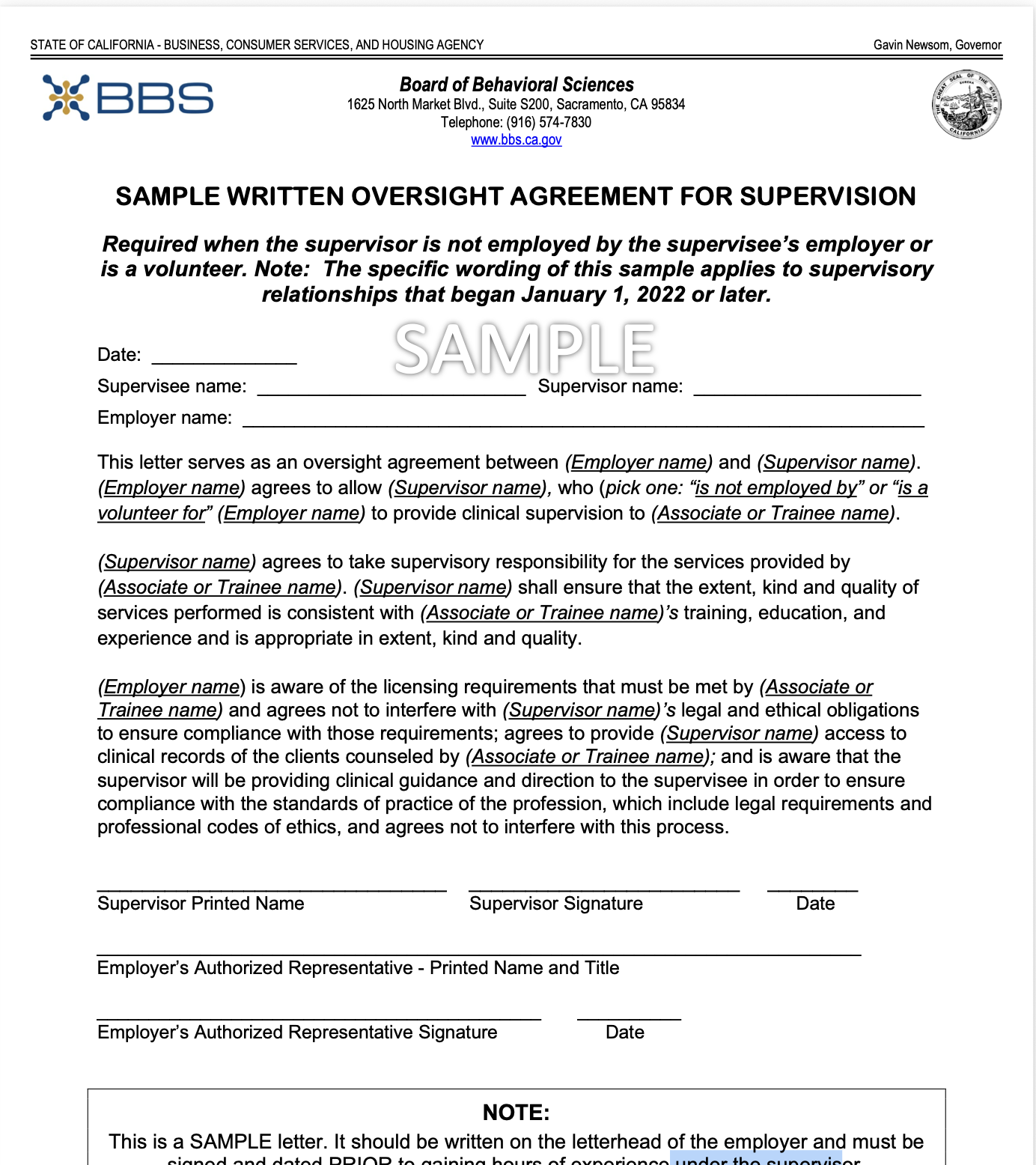
If your employer does not have a qualified supervisor on staff, they can contract with an outside clinical supervisor to provide supervision. But this arrangement does not happen informally. California law is specific about what has to be in place before a contracted supervisor can legally supervise you and sign your hours.
The law states that if a registered associate is working in a private practice or professional corporation, the supervisor must be employed by or contracted by the associate’s employer, or be an owner of the practice. The supervisor must also either provide psychotherapeutic services to clients for the associate’s employer, or have a written contract with the associate’s employer that gives the supervisor the same access to the associate’s clinical records as employees of that employer have.
In plain language, that means two things.
Your employer must formally agree to the arrangement. You cannot simply hire your own supervisor without your employer’s knowledge and consent. They need to be part of this process from the beginning.
Your employer and your contracted supervisor must sign a written oversight agreement. This document ensures that your supervisor has legal access to your clinical records and that your employer has authorized the supervision relationship. Without it, your supervisor cannot legally review your work, and the hours may not count.
The oversight agreement form is available through the BBS. The wording in the document must be exact, you cannot paraphrase or adapt it but it should be placed on your employer’s letterhead. Both your employer and your supervisor sign it. You should receive a copy, and you should keep it somewhere safe because you will need to submit it with your licensure application.
This form belongs to you. It is your documentation that your employer gave a contracted supervisor permission to supervise you and sign off on your hours. Do not let it get lost in an onboarding folder you never look at again.
In my experience, most employers are willing to enter into this agreement once someone explains what it requires and why it matters. I have had one agency decline, and I suspect they were simply new to the process and not yet ready to engage. That happens. It is not the end of the road, but it is a conversation worth having early, before you have already started accumulating hours you cannot verify.
Who Pays for Clinical Supervision?
This is the question nobody wants to ask out loud in a job interview, and it is exactly the question you need to ask before you accept an offer.
The straightforward position is this: your employer should pay for clinical supervision because supervision is part of your work. You are working when you are in supervision. It is not a personal professional development expense. It is a legal requirement of the California Department of Consumer Affairs for anyone providing clinical mental health services. The hours you spend in supervision are billable to your employer, not to your personal budget.
That said, not every employer sees it that way. Some will push back. Some will argue that supervision is your responsibility because licensure benefits you professionally. That argument has some surface logic to it and it is mostly wrong. Know the difference.
There are three realistic pay models you will encounter in the field:
Your agency’s time, your agency’s dime. Your employer pays for supervision and allows time during work hours for you to attend. This is the model you should be advocating for. It is the most equitable arrangement and the one most consistent with California’s intent.
Your agency’s time, your dime. Your employer allows supervision time during work hours but expects you to pay for it out of pocket. This is worth pushing back on. I have never had an associate pay for their own supervision, and I would be cautious about any employer who makes this a non-negotiable condition of employment.
Your time, your dime. You pay for supervision and do it outside of work hours, on evenings or weekends. Before you agree to this arrangement, check with your local labor laws. In California specifically, if supervision is a requirement of the job, requiring you to do it off the clock is worth scrutinizing carefully.
Real talk: If an employer cannot tell you clearly who pays for supervision and when it happens, that is useful information about how organized their clinical infrastructure is. It may not be a dealbreaker, but it is a data point.
The most productive thing you can do if your employer is resistant is to have an honest conversation about the legal requirement and what it means for the agency, not just for you. If you need backup in that conversation, that is something a contracted clinical supervisor can help with. I have spoken directly with employers to explain the supervision requirement and advocate for their newly hired associate. Most of the time, once an employer understands what is at stake legally, they find a way to make it work.
The Paperwork: What You Need and When You Need It
Clinical supervision in California comes with a paper trail, and that paper trail is your protection. Every form listed below serves a purpose, and every form belongs in a file that you maintain independently of your employer. Do not assume your agency is keeping track of this on your behalf. They may be. They may not be. Either way, you are the one applying for licensure, and you are the one who will be asked to produce documentation when that time comes.
Here is what you need to know about each document:
| Form | When It Is Signed | Who Signs It | Purpose |
| Supervision Agreement | Within 60 days of starting supervision | Supervisor and supervisee | Establishes the supervision relationship and includes the supervisory plan |
| Written Oversight Agreement | Before supervision begins, when required | Supervisor and employer | Required when the supervisor is not employed by the supervisee’s employer or is a volunteer |
| Weekly Log of Experience Hours | Weekly | Supervisor signs weekly | Documents hours while supervision is ongoing; retained unless the BBS requests it |
| Experience Verification | At the end or termination of supervision with that supervisor | Supervisor signs | Verifies total hours completed under that supervisor; submitted with the licensure application |
A few things worth highlighting in that table.
The Supervision Agreement must be signed within 60 days of starting supervision, not at some point when you get around to it. If you are already in a supervision relationship and this has not been signed, address it now.
The Written Oversight Agreement must be signed before supervision begins. Not during. Not after you have already accumulated a month of hours. Before.
The Weekly Log of Experience Hours is yours to maintain every single week. Do not let this slip. Gaps in your log create questions at licensure that are very difficult to answer retroactively.
The Experience Verification form is signed at the end of your supervision relationship with a particular supervisor, not at the end of your entire supervised experience. If you change supervisors, you need one from each.
Pro tip: Create a folder right now, physical or digital, labeled with your name and your BBS registration number. Every signed form goes in it immediately. Your future self, sitting across from a BBS licensing analyst, will thank you.
Before You Panic
If you are reading this post because you just accepted a position and realized the agency has no supervision structure in place, take a breath. This is solvable. California law was designed with this situation in mind, and contracted supervision exists precisely to fill this gap.
What it requires is a conversation with your employer, some paperwork, and a willingness on everyone’s part to do this correctly from the beginning. Most agencies, once they understand what is legally required and what is at stake for their associate, are willing to engage. The ones that are not willing to engage are telling you something important about how they operate. Listen to that.
You deserve a supervision arrangement that is legal, documented, and actually designed to help you grow as a clinician. Not just a signature. Not just a formality. The real thing.
We will keep building on this in the posts ahead.
Gracias,
Dr. Vero
References
California Board of Behavioral Sciences. (n.d.). Licensed clinical social worker. California Department of Consumer Affairs. Retrieved June 10, 2026, from https://www.bbs.ca.gov/applicants/lcsw.html
California Board of Behavioral Sciences. (n.d.). Licensed marriage and family therapist. California Department of Consumer Affairs. Retrieved June 10, 2026, from https://www.bbs.ca.gov/applicants/lmft.html
California Board of Behavioral Sciences. (n.d.). Licensed professional clinical counselor. California Department of Consumer Affairs. Retrieved June 10, 2026, from https://www.bbs.ca.gov/applicants/lpcc.html
California Board of Behavioral Sciences. (n.d.). Supervisor resources. California Department of Consumer Affairs. Retrieved June 10, 2026, from https://www.bbs.ca.gov/licensees/supervisor.html
California Board of Behavioral Sciences. (n.d.). Supervision agreement between the supervisor and supervisee. California Department of Consumer Affairs. https://www.bbs.ca.gov/pdf/forms/supervision_agreement.pdf
California Board of Behavioral Sciences. (2022). Supervision-related regulation changes for individuals gaining hours of supervised experience toward licensure. California Department of Consumer Affairs. https://www.bbs.ca.gov/pdf/law_changes_2022/supervision_reg_changes.pdf
California Business and Professions Code § 4980.43. https://codes.findlaw.com/ca/business-and-professions-code/bpc-sect-4980-43/
California Business and Professions Code § 4980.43.1. https://law.justia.com/codes/california/code-bpc/division-2/chapter-13/article-1/section-4980-43-1/
California Business and Professions Code § 4980.43.2. https://law.justia.com/codes/california/code-bpc/division-2/chapter-13/article-1/section-4980-43-2/
California Code of Regulations, title 16, § 1820. https://www.law.cornell.edu/regulations/california/16-CCR-1820
California Code of Regulations, title 16, § 1833. https://www.law.cornell.edu/regulations/california/16-CCR-1833
California Code of Regulations, title 16, § 1833.1. https://www.law.cornell.edu/regulations/california/16-CCR-1833.1
Leave a Reply